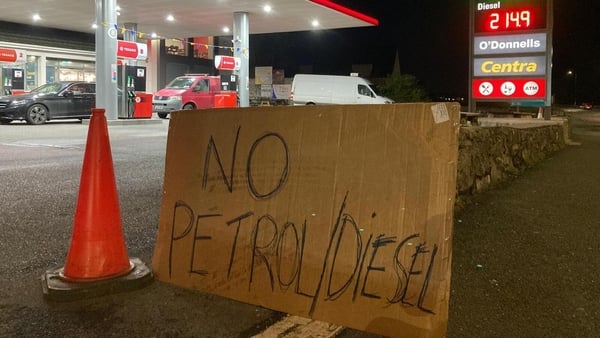

The number of service stations across the country without fuel has fallen to around 300 - down from more than 600.
It comes as fuel supplies to forecourts continue to recover following blockades of two fuel terminals and the country's only oil refinery last week.
Meanwhile, fuel prices have started coming down on some forecourts, as fresh excise cuts came into effect at midnight.
Under the excise cut measures, taxes on a litre of both diesel and petrol have been reduced by 10 cent until the end of July.
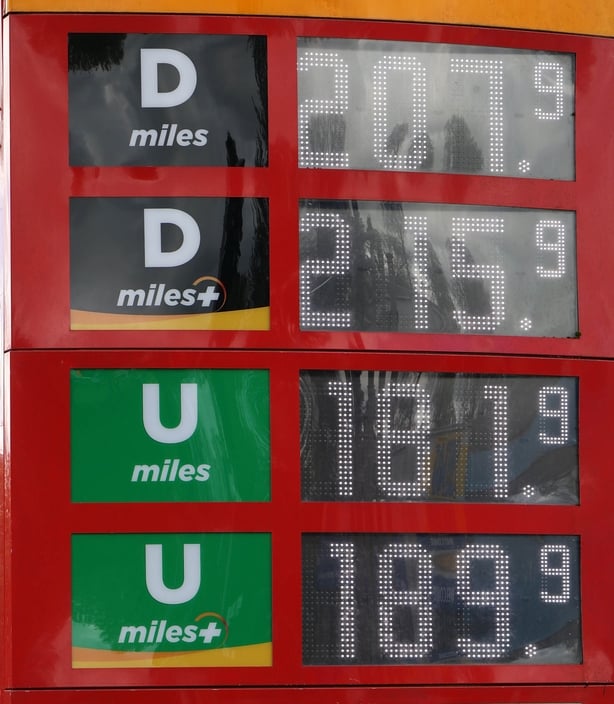
As a result, diesel has fallen to around €2.08 per litre in certain areas, while petrol has dropped to around €1.82 per litre.
Any fuel leaving a depot headed for a forecourt since midnight has been subject to the lower excise rates, however, many service stations might be selling existing stock on which they would have paid a higher excise rate.
Drivers fuel up after cut to tax on petrol and diesel
Fuels for Ireland said that in recent days the industry has been operating under "disrupted conditions" and as a result of this "some of the fuel arriving at sites in the immediate aftermath of the change will still have left facilities at the old excise rate".
The industry body said the reduction is coming through, but there will be a "lag as lower-duty fuel works its way through the system".
The latest measures follow a first round of excise cuts on fuel last month.
The total tax reduction on diesel since March is 32 cent a litre, while the overall reduction on petrol since March comes to 27 cent a litre.
Social Democrats bring motion on solar panel scheme to tackle energy crisis
Social Democrats leader Holly Cairns has called on Government to double the household solar panels grant to €3,600 in a bid to address surging energy prices.
Speaking during a Dáil motion from her party this morning, Deputy Cairns said she believes the changes are needed to address the "crushing anxiety for people" across Ireland and the reality the country is "vulnerable to sudden price hikes".
The party's Solar For All plan says doubling the existing household solar panels grant to €3,600 would save families and individuals in the region of €450 a year.
Deputy Cairns said this move is needed now, saying the protests of the past week "are a symptom of a wider problem" it would help to address.
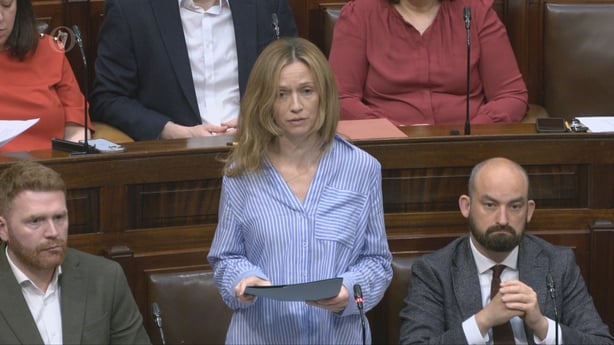
Social Democrats TD Liam Quaide said current Government measures to address rising energy and fuel costs are too broadly applied and risk delivering only short-lived relief.
Speaking in the Dáil, Mr Quaide warned that any gaps in support "will evaporate quickly if the situation in the Middle East becomes more entrenched", pointing to the potential for further energy price shocks.
He argued that measures such as fuel tax reductions provide only limited and temporary benefits.
"If you reduce fuel taxes, everybody who buys fuel gets some minor, short-lived benefit," he said, adding that this includes both households under significant financial strain and those better able to absorb rising costs.
Deputy Quaide also highlighted limitations in the fuel allowance scheme, noting that while extensions can help those who qualify, many households just above the eligibility threshold remain under pressure. He said that, despite Government claims of targeted support, "substantial sums" are still being spent "in a very diffuse manner".
The Social Democrats' motion, he said, offers a more focused alternative. It includes a proposed €400 energy credit for households on low to middle incomes, which he described as a more direct way to support those facing increasing bills.
In addition, the party is calling for a supplementary scheme aimed at essential workers such as carers and nurses.
Responding to the Social Democrats motion, Minister for Climate Darragh O'Brien said "no one in Government, certainly not me, is telling people everything's alright" but said the Coalition has introduced measures to help people with energy costs.
Minister O'Brien said while recognising "very clearly" the difficulties for people across the country, Government has already introduced "practical supports" on 1 April including a "reduction in diesel and petrol by 10 cent".
The Fianna Fáil TD said "a quarter of households in the country receive a direct payment from the fuel allowance" and that "it's just a fact" the Coalition has made "interventions" to address difficulties.
He said these include "a raft of social welfare measures", changing the income limit for carers benefit, and an increased focus on renewable energy schemes.
Minister O'Brien said while he has heard disagreement over the level of renewable energy usage in Ireland, he said the amount of renewable energy used by the national energy grid has risen from 19% in 2015 to 49% today.
He said this is a "really significant rate" and welcomed how today's Dáil debate could take place "in a calm and civilised way".
We need your consent to load this rte-player contentWe use rte-player to manage extra content that can set cookies on your device and collect data about your activity. Please review their details and accept them to load the content.Manage Preferences
Read more: What do the latest fuel excise cuts mean for pump prices?
Additional reporting Fiachra Ó Cionnaith