Marching bands from across the north west converged on the streets of An Clochán Liath in west Donegal to celebrate the fife and drum tradition.
Some 11 flute bands from west Donegal came together as The Rosses fifers united, before they embarked on the competitive marching season.
The annual Easter Sunday parade provides a showcase of a tradition that is deeply rooted in the communities of west Donegal, as 14 bands in total took to the streets.
Following the convergence of the bands, they competed for a list of titles, including best band, best drum major, best drum corps and the John Walsh Memorial Trophy.
Fife and drum marching bands in Donegal are a deeply rooted tradition, particularly in the west, with groups like An Mullach Dubh Band, established in the 19th century.
An Machaire band member Karl Doherty said the uniting of The Rosses fifers unite brings the communities of west Donegal together as they march to the beat of the same drum.
He said the event would not happen without the support of local businesses and traders.
The fife and drums bands perform at St Patrick's Day parades, local festivals including the Mary From Dungloe, and compete in competitions such as the Fleadh Cheoil na hÉireann.
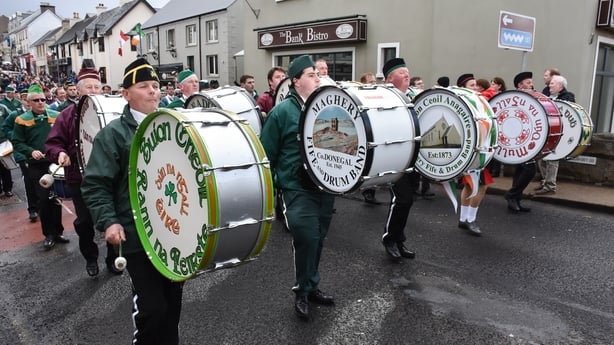
The Easter Sunday competition in An Clochán Liath started on 5 April 1953.
The competition originally had a closed section for local bands and an open section.
An Machaire have won the last six Easter Sunday competitions and they are aiming for seven in a row.
There was a powerful spectacle that marked the start of the competitive marching season as musicians marched to a collective rhythm that celebrates community spirit and heritage.
Geraldine Bonner from An Machaire said the coming together of different generations showcased the fife and drum tradition in the region.
Caitríona Boyle from Mín na Croise Band described the Easter Sunday Parade as a "huge day" for the community.
"We are 153 years marching in Dungloe and it's a legacy that has been left to us by those who have gone before us.
"To be part of it; all our families and communities joining together as a fife band. It’s a huge day for us," she said.
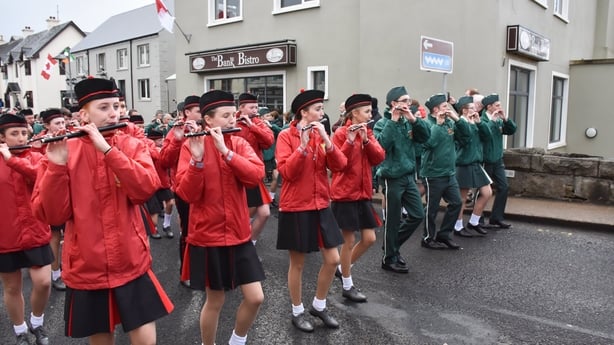
Eighty-two-year-old Bernard Duffy, who joined Buíon Cheoil Anagaire at ten years of age, said he hopes to play for another ten, at least.
"Since I joined, there have been a lot of changes. I’m playing 72 years now. I hope to play for another ten years. We’ll see how it goes. It means a lot to me," he said.
Bernard Devanney from Buíon Cheoil Anagaire said it is challenging to keep bands together, given the prevalence of emigration.
"There’s a lot of emigration in this part of the country. It’s hard to keep a band together. We do as much as we can.
"It’s an Irish thing that we keep going. It’s lovely to see so many bands out today," he said.
Jimmy Brennan from the Buíon Cheoil Mhín na Croise, who began playing 67 years ago, said the sense of community is huge.
"Right around the Rosses, there are marching bands everywhere, getting all those to come together as one group is unbelievable," he said.
Anne Bell from Dublin, visiting on holiday, described it as "a wonderful parade," adding that it was wonderful to have families together.
Marian Hall from An Clochán Liath described it as part of the fabric of the community.
"It’s holds them together. It’s just wonderful. I wouldn’t miss it for the world," she said.
Patrica Gillespie, who was in a band with her siblings in her youth, attributes the ongoing tradition to a love of music.
"The love of music that where it comes from. It was fostered back then, and it continues now," she said.