

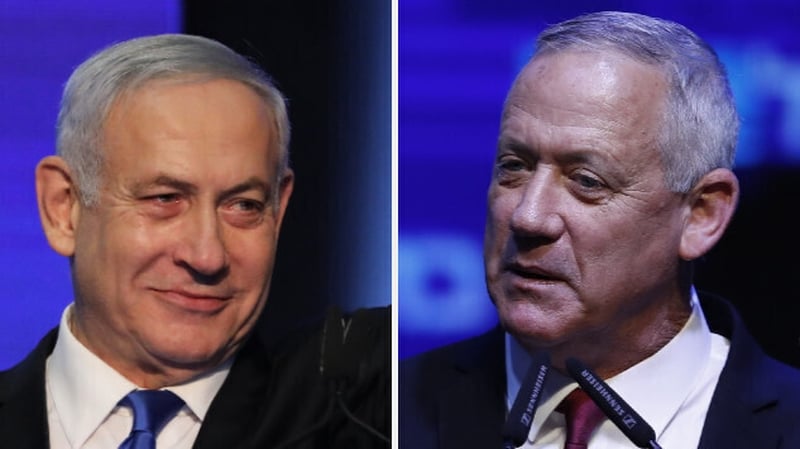
Israel's parliament dissolved on Wednesday after Prime Minister Benjamin Netanyahu's fractured ruling coalition failed to pass a budget, triggering a fourth election in two years and renewing an unprecedented political crisis.
The coalition led by Mr Netanyahu and his former election rival, Defence Minister Benny Gantz, had been inching towards collapse for weeks, undermined by mutual acrimony and mistrust.
The dissolution of parliament, the Knesset, could see elections held as early as 23 March, likely forcing Mr Netanyahu to seek re-election while the coronavirus pandemic is still raging and as his long-awaited corruption trial intensifies.
The coalition headed by Mr Netanyahu's right-wing Likud and Mr Gantz's centrist Blue and White party had until midnight to pass a 2020 budget.
Failure to do so legally forces parliament's dissolution, Knesset spokesman Uri Michael told AFP on Tuesday.
The deadline's expiration marks the end of a troubled political marriage between Netanyahu and Gantz, who faced off in three inconclusive elections in April and September of 2019 and again in March.
Budget battle
They agreed to form a so-called unity government in April.
Mr Gantz has said he never trusted Mr Netanyahu, but wanted to spare Israelis a fourth election, especially as the pandemic was gathering pace.
The three-year coalition deal had stipulated that Mr Netanyahu serves as premier for 18 months, with Mr Gantz taking over in November 2021.
Mr Gantz demanded the government pass a budget covering both 2020 and 2021, arguing Israel, and the coalition, needed stability.
But Mr Netanyahu refused to endorse a 2021 budget.
That, his critics said, was a political tactic to keep the coalition unstable, making it easier for him to sink the government before he had to yield power to Gantz.
"The reason we're heading to an election is because Netanyahu refused to pass a budget as required by law and honour political agreements so that he can remain in power for the duration of his trial," said Yohanan Plesner, the head of the Israel Democracy Institute think-tank.
Late Sunday, Blue and White said it had an agreement with Likud on a bill to buy more time to pass the budget.
But the Knesset rejected that bill on Tuesday, following yet another round of bitter back-and-fourth between Netanyahu and Gantz.
Lawmakers from Likud and Blue and White both voted against the coalition proposal.
Mr Gantz, currently in precautionary coronavirus quarantine, was unable to vote.
'Risk all around'
Both Mr Netanyahu and Mr Gantz face substantial political risks in new elections, especially if held in March.
Political commentators have said Mr Netanyahu always planned to force an election before vacating the premier's office for Gantz, but would have preferred a vote date in June or later.
That would have allowed more time to vaccinate the public against the novel coronavirus and hopefully push Israel's economy towards recovery.
A March election would compel Mr Netanyahu to campaign in February, when he is due to appear in court multiple times a week for his trial on charges of bribery, fraud and breach of trust.
He is accused of accepting improper gifts and seeking to trade favours with media moguls in exchange for positive coverage, but denies wrongdoing.
Mr Netanyahu also faces a new challenge from influential right-winger Gideon Saar, who has left Likud to form his own New Hope party.
