


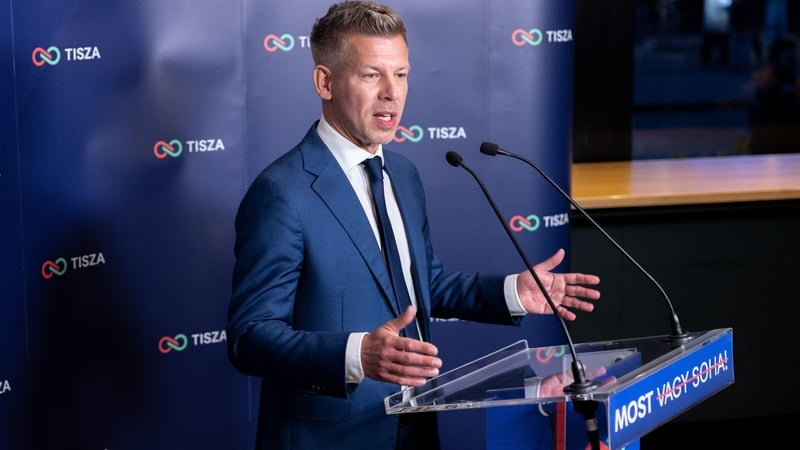
Hungary's new parliament will convene in early May to formally elect Peter Magyar as premier, following his landslide victory of the 16-year rule of nationalist Viktor Orban.
Mr Magyar, who routed Orban in an election on Sunday, said the new parliament could convene as early as 4 May or around 6-7 May, after meeting with President Tamas Sulyok to discuss the issue.
He called on the Orban ally to resign to complete a fresh start for the central European EU and NATO member after an election that gave his party a two-thirds majority in the chamber.
"I repeated to him that, in my eyes and in the eyes of the Hungarian people, he is unworthy of embodying the unity of the Hungarian nation, incapable of ensuring respect for the law," Mr Magyar told journalists after the meeting.
If the president refuses to step down, Mr Magyar added, his government will introduce a law removing him and "all the puppets nominated to top posts by the Orban system". He said the posts included the chief prosecutor and the head of the constitutional court.
He said the president, who is elected by parliament and has a largely ceremonial role, had responded "enigmatically" to the demand.
Mr Magyar's Tisza party won a two-thirds majority in the elections - giving him the power to amend the constitution.
Orban met separately with the president, who was to speak with all party leaders on Wednesday.
In a Facebook post, Mr Sulyok said only that he would officially nominate Mr Magyar to the post of prime minister during the inaugural parliament session.
Uprising anniversary
Mr Magyar, 45, a conservative who became an outspoken opponent of Orban's rule, has vowed to bring in a "new era" and "regime change" that would roll back many of the actions taken by Orban and his Fidesz party to increase his control of state institutions and civil rights.
The government will make a priority of reforms - notably in justice and against corruption - that will help unblock billions of euros of European Union funds frozen by Brussels.
Mr Magyar said he had invited several international leaders to visit Budapest for the 70th anniversary on 23 October of the 1956 uprising against Hungary's pro-Soviet government at the time.
Orban, an ally of US President Donald Trump and Russia's President Vladimir Putin, lost the elections after 16 years in power.
Mr Trump had vocally endorsed Orban, but said on Tuesday he liked Mr Magyar, telling ABC News: "I think the new man's going to do a good job - he's a good man."
Mr Trump noted that Mr Magyar was formerly a member of Orban's party and said he had similar views on immigration, according to ABC News correspondent Jonathan Karl, who posted the remarks on X.
Mr Magyar said he welcomed Mr Trump's "very friendly" comments.
We need your consent to load this rte-player contentWe use rte-player to manage extra content that can set cookies on your device and collect data about your activity. Please review their details and accept them to load the content.Manage Preferences
EU says Orban loss gives 'new push' to Ukraine accession
The change in Hungary's government could help unlock €90 billion for Ukraine and give a "new push" for it to join the European Union, the bloc's expansion chief has said.
Commissioner for Enlargement Marta Kos speaking on the sidelines of the IMF and World Bank spring meetings, described the Hungarian election on Sunday - which saw long-ruling nationalist prime minister Viktor Orban face a heavy defeat - as a "big win for Europe."
"I expect, personally, that this will have a positive effect on the accession process," Ms Kos said.
She also said it would help unlock a major loan needed to prop up Ukraine's budget.
Mr Orban had an effective veto on the funds, angering other EU leaders. He had tied the veto to a dispute with Ukraine over a damaged pipeline carrying Russian oil.
"With the €90 billion, we can cover the financial needs of Ukraine in '26 and '27," Ms Kos said.
Mr Orban also opposed any progress on Ukraine joining the European Union.
Despite her upbeat tone, Ms Kos cautioned that Ukraine still needed "to deliver on the reforms which are important for their economic transformation," while acknowledging this was not easy for a country at war.
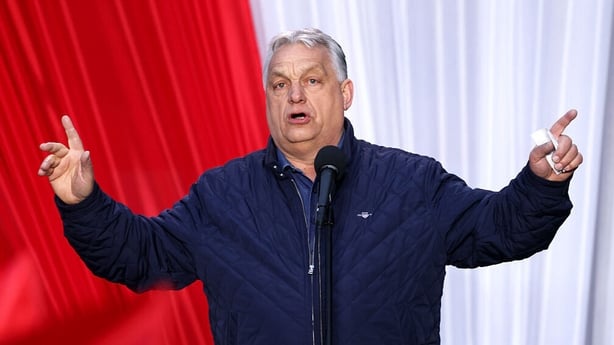
Mr Orban, a right-wing populist who held power for 16 years, was defeated by conservative Peter Magyar in elections held on Sunday.
Mr Magyar, for his part, opposes rapid EU accession for Ukraine as well as sending military aid to Ukraine, but could unblock the loan as a goodwill gesture to leaders in Brussels.
He has vowed a referendum on Ukraine's EU membership, but he could allow the bloc to move forward with so-called negotiating "clusters" that Brussels has pushed for.
Ms Kos also said she hoped to see the new Hungarian government bolster anti-corruption efforts, strengthen the rule of law, and increase the media freedoms.
"Those fundamentals - we put so much effort in the accession process - are also important for the member states," she said, referring to Hungary.
Hungary's Magyar promises to suspend state media broadcasts
Mr Magyar also said this morning that his government will suspend state media broadcasts, pass a new media law and ensure press freedom after his cabinet takes power.
"Every Hungarian deserves a public service media that broadcasts the truth," Mr Magyar said on Kossuth state radio, where outgoing Prime Minister Viktor Orban had been a weekly guest for the past 16 years while opposition politicians rarely got invited.
"We will need a little time to pass a new media law, a new media authority and setting up the professional conditions for state media actually do what it is meant to do," Mr Magyar added.
After a year and a half, I am back in the "public" television studio. We have just witnessed the last days of a propaganda machine.
— Magyar Péter (Ne féljetek) (@magyarpeterMP) April 15, 2026
After the formation of the TISZA government, we will suspend the news services of the "public" media until its public service character is restored. pic.twitter.com/KW6UQsKzJP
Critics say public media served as a government mouthpiece under Mr Orban and accused him of presiding over the undermining of independent media as allies of his Fidesz party took control of private outlets - charges he denied.
Mr Orban's landslide defeat handed Mr Magyar a strong majority in Hungary's 199-seat legislature, opening the door for an overhaul of a system that critics in the European Union said subverted democratic norms.
